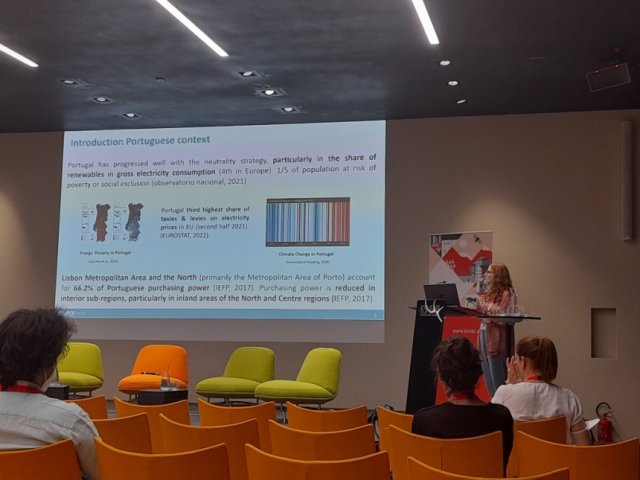
Katherine Mahoney presents at 4th International Conference SSPCR Smart and Sustainable Planning for Cities and Regions 2022, Bolzano Italy
July 19, 2022 from 10:00 to 16:00
Participants: Katherine Mahoney
Katherine's presentation was entitled: "Exploring regional injustices in the Portuguese energy transition"
A brief abstract of the work presented at the conference follows, this work was developed by Katherine, João Pedro Gouveia and their colleague Rita Lopes. This work is part of the larger body of work of Katherine's PhD and is currently being developed further.
Abstract:
Delivering an energy transition (ET) which “leaves no-one behind” while alleviating injustices in vulnerable regions are pillars of contemporary European and Portuguese energy policy. North and inland regions of Portugal present a higher risk of energy poverty and poorer building energy performance, yet the impact of the ET on these regional injustices are poorly understood, potentially compromising principles of democracy in the ET.
Focusing on energy poverty and linked concepts we aim to address this information gap through semi-structured qualitative interviews with field experts. In so doing we contribute to the topic “Strengthening democracy in the energy transition”, our preference is to deliver this work in a presentation format. Our interview results will be subject to qualitative validation processes. Data quality is ensured through an inclusive approach to participant selection. Our results reveal a shared perception among participants that threats to a just transition are concentrated in rural Portuguese regions. These threats include reduced participation in energy efficiency programmes in rural versus urban zones and the focus of job creation and transition benefits in urban economic centres. Injustices linked to exploratory mineral extraction in rural regions with low contributions to national GHG emissions are also highlighted.
In conclusion, significant participant perceptions are the uneven distribution of ET benefits between rural and urban regions, with implications for energy poverty and broader justice concerns. Key policy recommendations are improved targeting of energy efficiency programmes for those most in need and improved balancing of employment opportunities across the country to efficiently tackle existing geographic inequalities and deliver a democratic ET.
SHARE ON