#INDIA#LPG#CLEAN COOKING#ENERGY PRICES
Journal : Policy Edge
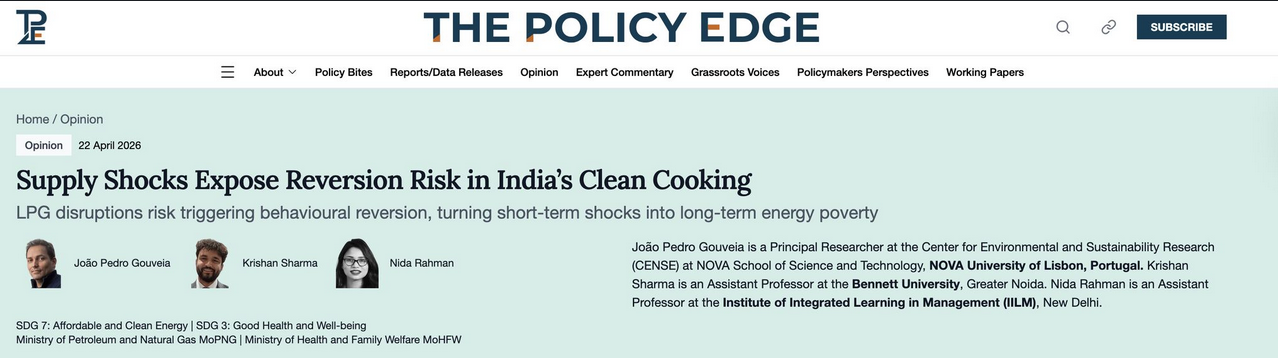
When a supply disruption hits, what happens to a household that has just switched to cleaner cooking?
This is the question at the heart of a new op-ed co-authored with K Sharma and Rahman Nida, published in The Policy Edge.
India has made remarkable strides in expanding access to LPG through the Pradhan Mantri Ujjwala Yojana, with over 100 million subsidised connections reaching households that previously had none. But access, as we argue, is not the same as a strong and lasting energy transition.
When supply chains are disrupted, as recent tensions in the Strait of Hormuz have shown, the real test begins for many regions. Many low-income households never fully abandoned traditional fuels, such as biomass. They simply added LPG to the house mix. When disruptions occur, falling back on firewood or biomass is frictionless, but recovering that ground is not.
And looking further ahead, the challenge deepens: if households cannot sustain the intermediate step of clean fossil fuels, the path toward renewable-based cooking solutions, such as biogas, solar, and electric induction, becomes even harder to navigate.
What makes this particularly challenging is that reversion can occur invisibly, with households retaining their LPG connections while quietly returning to older fuel practices. Official statistics may show no change, while on-the-ground reality has shifted.
The policy implication is clear: expanding connections was a necessary first step. But sustaining the transition requires a different kind of policy design, one that protects affordability under stress, measures actual usage rather than nominal access, and treats clean cooking as a continuity-dependent welfare system.
A small piece of work with some broader resonance, because the dynamics of energy poverty reversion are not unique to India.
Full publication here.