ENTRACK work featured in Edificios e Energia Magazine
October 16, 2026
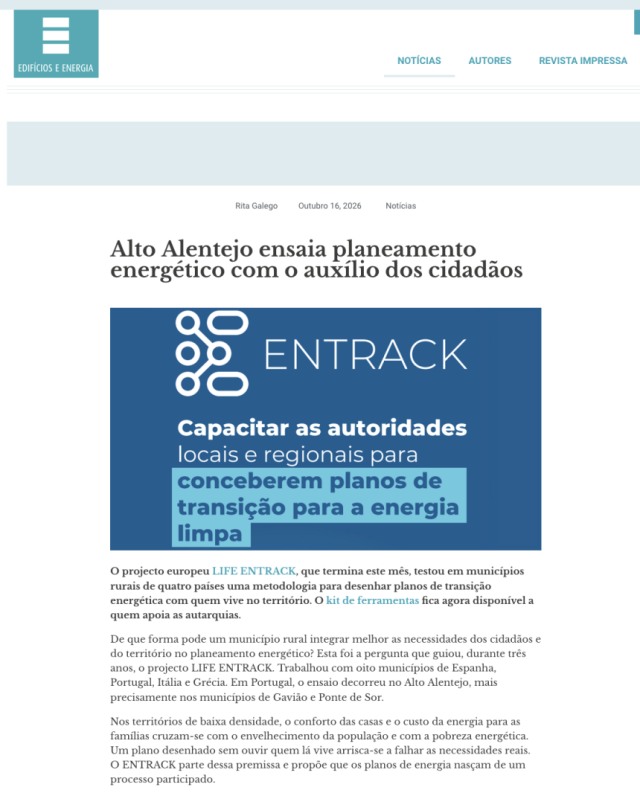
The European LIFE ENTRACK project, which concludes this month, tested a methodology in rural municipalities across four countries to design energy transition plans with the involvement of local communities. Its toolkit is now available to organisations that support local authorities.
How can a rural municipality better incorporate the needs of its citizens and local area into energy planning? This was the question that guided the LIFE ENTRACK project over three years. The project worked with eight municipalities in Spain, Portugal, Italy and Greece. In Portugal, the pilot took place in Alto Alentejo, specifically in the municipalities of Gavião and Ponte de Sor.
In sparsely populated areas, home comfort and household energy costs intersect with an ageing population and energy poverty. A plan designed without listening to local residents risks failing to address their actual needs. ENTRACK is based on this premise and proposes that energy plans should emerge from a participatory process.
A methodology tested on the ground
Approved under the LIFE22-CET (Clean Energy Transition) call of the LIFE Programme, the project is coordinated by the Italian organisation AISFOR. In Portugal, it involves AREANATejo and NOVA University Lisbon.
Its aim is to provide local and regional authorities across the Mediterranean with the knowledge and methodological approach needed to design energy transition policies and plans through the active participation of all stakeholders. More specifically, it seeks to accelerate carbon neutrality by strengthening the energy policy-making capacity of small and medium-sized rural municipalities.
The work is based on Municipality-Region Partnerships (MRPs), collaborations between local and regional governments that bring together elected officials, businesses—particularly those in the energy sector—citizens (including vulnerable groups), civil society organisations and environmental associations. In Portugal, the MRP is coordinated by NOVA FCT in partnership with AREANATejo.
The list of participants is extensive. In addition to the municipalities of Gavião and Ponte de Sor, the partnership includes the Alto Alentejo Intermunicipal Community, the Alentejo Regional Coordination and Development Commission (CCDR Alentejo), Sociedade Portuguesa de Inovação, the CENSE research centre and the European Anti-Poverty Network (EAPN).
Local community organisations are also involved, including the Commission for the Protection of Children and Young People and the Gavião Senior University; the Ponte de Sor Rehabilitation and Inclusion Centre; the Foros de Arrão Centre for the Interpretation of Milling Heritage; the Portalegre District Social Security Centre; and the Comenda Digital and Intangible Archive.
The latter is a non-profit philanthropic initiative dedicated to the sustainable development of rural communities, particularly in Gavião, where a Renewable Energy Community is being established to strengthen social cohesion and combat energy poverty.
Five steps, from the survey to the plan
In each region, two pilot municipalities followed the same process.
First, a mixed group of public- and private-sector stakeholders was established to support the development of the methodology. This group was subsequently expanded to include a wider range of participants.
Next, a qualitative and quantitative survey was conducted among citizens and stakeholders to gather their knowledge and perspectives on energy transition policies.
The municipalities then analysed the results, with support from the project partners, to assess whether policy implementation was aligned with the expected impacts and objectives.
Based on this self-assessment, the municipalities proceeded to develop new Energy Plans or revise those already being implemented.
Finally, the plans are adjusted in response to feedback from the community.
From pilot project to wider adoption
The project's legacy is the ENTRACK Exploration Kit, a free digital resource. It includes methodologies, tools and templates to support collaborative design, training resources and practical examples, a suggested implementation timetable, and materials to help communicate and replicate the experience in other areas.
The toolkit is intended for supra-municipal authorities, energy agencies, local action groups, networks of municipalities and other organisations that support local authorities.
Brussels brings the project to a close
The ENTRACK Final Conference took place on 30 September in Brussels. It brought together project partners, policymakers, researchers, practitioners and other stakeholders from across Europe.
The event presented the project's main achievements and provided an opportunity to reflect on the knowledge, experiences and perspectives generated throughout its implementation. Participants exchanged experiences, discussed policy implications and explored approaches to supporting socially just and inclusive energy transitions in rural areas.
European institutions, regional and local authorities, academia, civil society and energy communities were all represented.
Following the Brussels conference, the team will continue to organise bilateral online meetings throughout this month to present the resources and explore how each organisation can use, adapt or transfer them to the municipalities with which it works.
Full article here.
RELATED NEWS
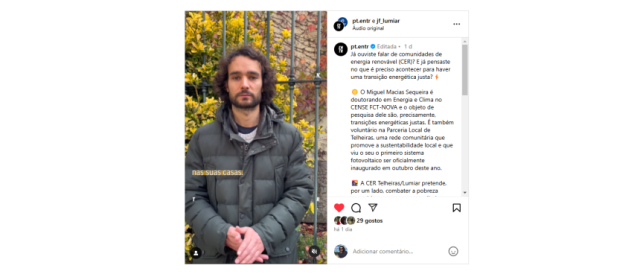
"Is the energy transition being fair?" - Miguel Macias Sequeira interviewed for a reels video of ENTR
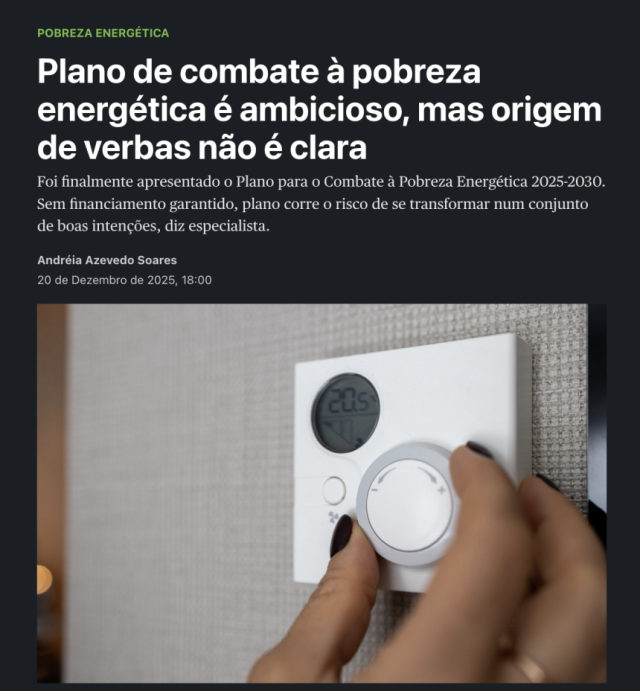
João Pedro Gouveia interviewed for PUBLICO regarding the new Energy Poverty Action Plan

Lançamento oficial do balcão único digital "Renovar Casa", que promete revolucionar a renovação de habitações em Portugal, Espanha e Itália!

LOCATEE Project promotional video

Miguel Macias Sequeira interviewed by Catarina Barreiros about the Iberian blackout

SHARE ON