João Pedro Gouveia coordinates new European project to fight energy poverty in Mediterranean countries
March 10, 2026
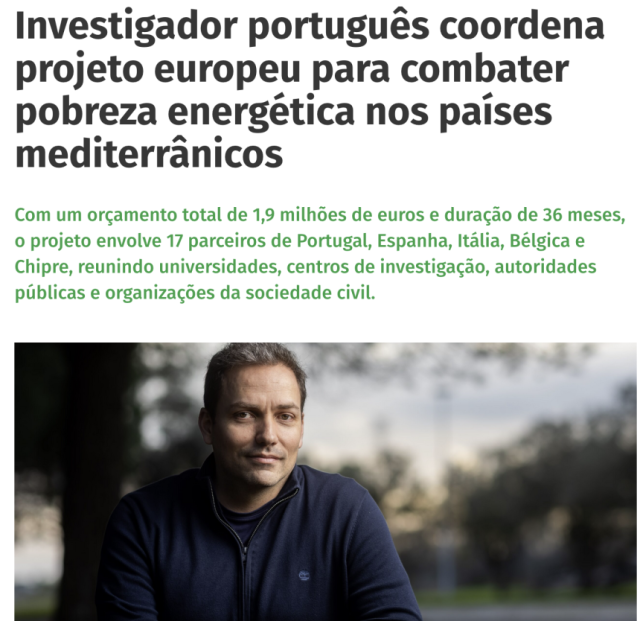
Portuguese researcher coordinates European project to combat energy poverty in Mediterranean countries
With a total budget of €1.9 million and a duration of 36 months, the project involves 17 partners from Portugal, Spain, Italy, Belgium and Cyprus, bringing together universities, research centres, public authorities and civil society organisations.
The Faculty of Sciences and Technology of NOVA University Lisbon | NOVA FCT announces, in a press release, that researcher João Pedro Gouveia, Principal Researcher at CENSE – Centre for Research in Environment and Sustainability, takes on the overall coordination of the European project EP-MED (LIFE-CET_ENERPOV), a strategic initiative to address energy poverty in the Mediterranean countries of the European Union.**
According to the same source, with a total budget of €1.9 million and a duration of 36 months, the project involves 17 partners from Portugal, Spain, Italy, Belgium and Cyprus, bringing together universities, research centres, public authorities and civil society organisations.
Energy poverty affects millions of people in southern Europe, where many households struggle to adequately heat or cool their homes due to high energy costs, low incomes and poor housing efficiency. This reality has significant impacts on the health, well-being and quality of life of the most vulnerable populations.
EP-MED aims to address this challenge through the creation or strengthening of National Energy Poverty Observatories in Portugal, Italy, Spain and Cyprus, as well as the establishment of Regional Centres in municipalities with high levels of vulnerability. These structures will directly support households and strengthen coordination between public and private entities.
The project adopts a cross-sectoral approach, promoting coordination between the health, housing, social welfare and energy sectors. Key planned activities include the development of comprehensive monitoring frameworks, support for the definition of national strategies, and the preparation of regional action plans.
EP-MED also addresses less studied dimensions, such as summer energy poverty — particularly relevant in Mediterranean climates — and the specific challenges faced by island regions of the European Union. The initiative builds on existing European programmes and promotes the direct involvement of citizens and stakeholders in the co-creation of solutions tailored to national contexts.
"It is essential to strengthen coordination between public policies and scientific knowledge in order to provide effective responses to the most vulnerable households. EP-MED will make it possible to structure networks and monitoring tools that ensure lasting impacts in the fight against energy poverty," highlights researcher João Pedro Gouveia.
Expected impacts include strengthened institutional capacities, transnational exchange of good practices, direct citizen engagement and the formulation of policy recommendations grounded in scientific evidence. The project also envisages the formalisation of partnerships with public authorities and policymakers, ensuring long-term sustainability and the potential for replication of the model in other regions of the European Union.
Full article here.
RELATED NEWS
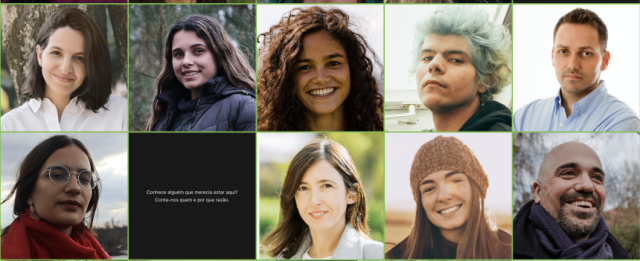
"Faces that want to change the future of the planet" featuring Dr. João Pedro Gouveia
"Portugal’s energy poverty paradox" for Canada's The Independent with Miguel Macias Sequeira
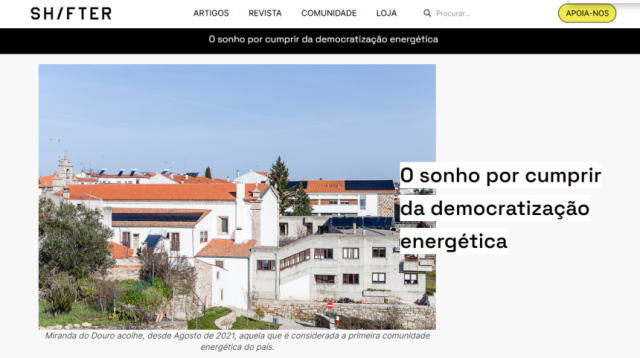
"The unfulfilled dream of energy democratization" with Miguel Macias Sequeira for SHIFTER
"This is where you die of cold" Energy Poverty in Portugal
ADENE interviews João Pedro Gouveia
SHARE ON