João Pedro Gouveia interviewed for the European Correspondent on the EU ETS2
September 30, 2026
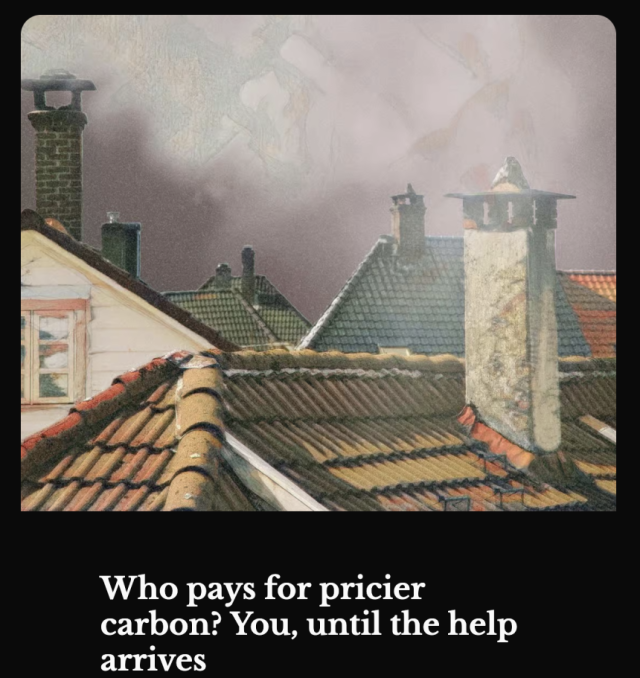
If you heat your home and fill up your car with gas, oil, or coal, your bills are likely going up from 2028. The EU’s new carbon pricing system, the Emissions Trading System 2 (ETS2), will make fossil fuel suppliers pay for the emissions from the fuel they sell, and they’ll pass that cost on to you.
For most households, the increase in heating costs will be modest at around €60 a year on average, according to estimates from the Bertelsmann Foundation.
But in Poland, households heating with oil, gas, or coal could pay €372 more each year. The hardest hit are often older homeowners in Slovakia, Hungary, Romania, and Poland, living on around half the average income in their countries. They already spend about 6% of their income on heating, and ETS2 could push that above 7%.
Three in four buildings in the EU are energy inefficient, so they use more energy than necessary and every price rise costs them more. At an EU-wide renovation rate of around 1% a year, most won't be fixed any time soon.
The EU is offering a safety net for the people hit hardest by ETS2: the Social Climate Fund. The fund has €86.7 billion to help them pay higher bills, insulate their homes, switch to heat pumps, and access cleaner transport.
Greece aims to renovate 62,000 dwellings and help pay for vulnerable households to make their homes more energy efficient with heat pumps and solar heating. Latvia will also cover up to €20,000 for renovations, and Sweden will pay eligible rural households up to €120 a month towards buying or leasing an electric car.
But most governments don't seem in a rush to get you that support. Every EU member state had to submit a spending plan by June 2025. More than a year later, only five – Sweden, Lithuania, Latvia, Malta, and Greece – have had theirs approved. Seventeen haven't sent one at all.
None of the four hardest-hit countries has submitted a plan, and their governments have resisted ETS2 itself: Poland successfully lobbied for a one-year delay to 2028, backed by other members including Slovakia and Hungary. Romania says it won't introduce the new carbon price until 2031.
These countries are some of the most reluctant to put a higher price on carbon, and still haven't worked out how to protect their citizens from it.
Another hole in this supposed safety net: even when plans are submitted, the money may not reach the people it’s designed for, according to João Pedro Gouveia, who researches energy poverty at NOVA University Lisbon.
Most countries plan to use income to decide if you qualify for financial support, Gouveia said. But energy poverty also depends on the state of your home, whether you rent or own, and whether you can afford upfront renovation costs.
A household earning just above the cut-off, living in a draughty, poorly insulated flat, can be effectively as vulnerable as one below it, yet receive nothing.
And governments often can't find them: data protection rules usually stop them from combining welfare and building data. “I cannot know if someone earns €1,000 and then lives in an F-class [one of the lowest energy ratings] or rented apartment,” Gouveia explained. “Public entities are not allowed to cross-check.”
Even households that qualify may have to wait. Renovation companies can't keep up with demand everywhere, Gouveia said. “If I reach out to a company to renovate and change my windows, the company would say, 'Okay, maybe in eight months from now, or next year. I have another family that needs 10 windows.'”
Gouveia thinks governments should prioritise the hardest-to-reach households, which is possible if they stop relying on income as the only factor: “There will not be one scheme that will address everyone in need.”
A good start would be to focus on the worst-performing buildings and have doctors, health centres, or municipal social services refer people.
Some of that work has already begun: in September, the EU's Energy Poverty Advisory Hub started helping 59 local governments find and support energy-poor households. It's a small start, but it shows the hole can be patched – if governments go looking for the people who fall through it.
Full article here.
RELATED NEWS

"Faces that want to change the future of the planet" featuring Dr. João Pedro Gouveia
"Portugal’s energy poverty paradox" for Canada's The Independent with Miguel Macias Sequeira
"The unfulfilled dream of energy democratization" with Miguel Macias Sequeira for SHIFTER
"This is where you die of cold" Energy Poverty in Portugal
ADENE interviews João Pedro Gouveia
SHARE ON