Euronews interviewed João Pedro Gouveia
November 16, 2026
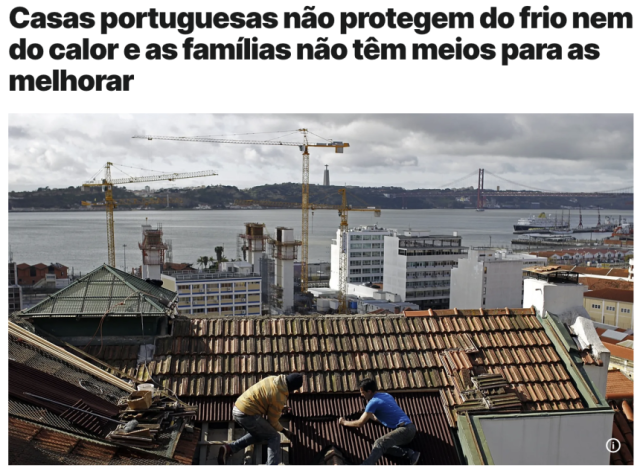
The cold in winter and the heat in summer continue to affect many Portuguese families, in a context of poorly insulated homes and financial difficulties that prevent them from improving their living conditions.
In Portugal, some people spend the winter feeling cold inside their homes, while others struggle to stay comfortable in summer because their homes become unbearably hot. Mouldy walls, dampness, inefficient windows, and a lack of insulation in walls and roofs are part of everyday life for a large proportion of Portugal’s housing stock. The problem is therefore not limited to the cold during the winter months: many homes are also ill-equipped to cope with the heat.
João Pedro Gouveia, Energy and Climate Coordinator at the Centre for Environmental and Sustainability Research (CENSE) and a lecturer at NOVA University Lisbon, began his interview with Euronews with an ironic remark, saying that “journalists only talk to him in winter”. However, he stressed that the problem with Portuguese homes has two dimensions: they are unsuitable both in winter and in summer.
The researcher told Euronews that the problem is not new and that numerous reports, studies and action plans have already been produced. However, what is needed is to “take action on the ground”, apply pressure and “keep the issue in the public eye”. He also called for greater “consistency” and “continuity” in policy measures, arguing that the political instability Portugal has experienced in recent years, with successive changes of government, has hindered the development of long-term strategies.
According to the latest Eurostat figures, in 2025, 15.6% of Portugal’s population was affected by energy poverty, meaning they were unable to keep their homes adequately warm.
An ageing housing stock
In Portugal, several municipalities have areas classified as vulnerable in terms of energy efficiency, including ARUs (Urban Rehabilitation Areas). These are designated areas within municipalities where buildings are in poor condition and require renovation.
“The majority of Portugal’s housing stock was built before 1990, before the introduction of the first thermal building regulations. Portugal was among the European countries that were slowest to introduce thermal regulations,” explains João Pedro Gouveia.
The researcher also points out that Portugal developed a building tradition “closely linked to the idea that the climate was mild”. As a result, the need to insulate buildings was largely overlooked, making this one of the most pressing priorities today.
On the other hand, “during the 1980s and 1990s, there was also a huge demand for housing, particularly in city centres, to accommodate people moving from the former Portuguese colonies in Africa to mainland Portugal, as well as those migrating from rural areas to urban centres”. This led to a construction boom involving buildings “of questionable quality” and a significant amount of “self-building”, with little regard for regulations.
“Even after 1990, when relatively basic regulations were in place, most homes still had no wall insulation, and windows were fitted with single glazing,” he explains.
Low incomes make it difficult to improve housing conditions
The combination of the country’s construction legacy, low household incomes and rising energy prices creates a particularly challenging situation, as many people simply cannot afford to improve their homes.
According to data from the National Observatory for Energy Poverty, around 32% of the population lives in homes affected by dampness or mould, and the trend has been worsening.
Drawing on his experience in the field, João Pedro Gouveia confirms these findings but believes that people are becoming more aware of the problem.
“People are no longer as resigned to being uncomfortable in their own homes as they once were. In the past, people thought it was normal to feel cold at home and simply wrapped themselves in a blanket. But, besides being unhealthy, it makes no sense for someone to be cold or overheated in their own home,” he explains.
Government support programmes attract strong demand, but little funding goes towards insulation
Evidence of this growing awareness can be seen in the uptake of successive government support schemes, such as the Sustainable Buildings Support Programme (PAE+S), which was first launched in 2020.
“We can see that funding schemes open to the general population, and not just vulnerable households, attract considerable demand. The second and third editions of the Sustainable Buildings Programme received more than 100,000 applications,” he recalls.
The PAE+S programme, promoted by the Portuguese Government and managed by the Environmental Fund, was created to encourage energy efficiency in homes. It aimed to support improvements such as replacing windows with more energy-efficient models, insulating walls, roofs and floors, installing heating and cooling systems such as heat pumps, and fitting photovoltaic solar panels for self-consumption.
However, the researcher stresses that there is not enough funding to reach more families.
“If there is a problem that affects people's health, productivity and different age groups, it needs to be addressed on a much larger scale,” he explains.
The programme operated on a reimbursement basis. Applicants had to pay for the improvements upfront and were subsequently reimbursed for part of the cost, depending on the work carried out and the supporting documentation provided. Reimbursement ranged from 65% to 85%, depending on the category, subject to maximum limits for each type of intervention.
The researcher also points out that the figures from the latest programme showed that only a small proportion of funding went towards what he considers a priority: roof insulation.
Most applications focused on installing A+ energy-efficient windows, heat pumps and air conditioning systems, as well as photovoltaic panels. Thermal insulation accounted for just 1.5% of applications.
“Because it is much easier and less expensive,” he initially explains. “There is already a more standardised system for installing windows, and the work is relatively straightforward. The same applies to air conditioning units and photovoltaic solar panels. But insulation is different: it involves much more extensive work.” In addition to being more complex, insulation can cost considerably more, easily exceeding €10,000.
The cost of renovations continues to leave families behind
Although the number of applications exceeded the funding available under the programme, many families were also unable to take part because they did not have the money upfront to carry out the improvements themselves.
Euronews obtained an estimate for renovating a three-bedroom home, based on market prices. Three standard-sized windows (120 x 110 cm), made of PVC with double glazing, tilt-and-turn opening mechanisms and a white finish, cost around €440 each, including installation. A larger window, for a kitchen with an enclosed balcony, cost approximately €775, also including installation. This means that replacing the windows in a home with these specifications would easily cost around €2,000, excluding VAT (which is charged at 23% in Portugal).
Unable to afford these costs, some households opt for cheaper solutions that provide immediate relief, such as oil-filled radiators or fans.
“The upfront investment required is very different. For example, people may not have €1,000 to buy and install an air-conditioning unit, so they will spend €100 on a fan or an oil-filled radiator that they simply plug in. But when you look at it, air conditioning is much more energy-efficient and makes more sense,” he explains.
The researcher therefore believes that energy literacy can be an important tool, with local businesses, such as shops selling these products, playing a key role.
“I think this kind of direct contact with people when they go shopping is a good solution,” he says.
Portugal also has a programme called Vale Eficiência (Energy Efficiency Voucher), aimed at vulnerable households. Under the scheme, the Government provides funding through a voucher worth €1,300 plus VAT.
However, João Pedro Gouveia, Energy and Climate Coordinator at CENSE, identifies two shortcomings in the programme. Firstly, it is only available to households receiving the Social Energy Tariff.
“We know that there are people living in energy poverty who may be just €100 or less above the threshold for receiving the social tariff and are therefore automatically excluded from this support.”
Secondly, the current Vale Eficiência scheme only covers window replacements, the installation of heating or cooling systems, and photovoltaic solar panels, leaving thermal insulation out of the programme.
In this regard, João Pedro Gouveia advocates an alternative model that he helped develop and for which he is providing technical support: the Green Funds (Fundos Verdes) introduced by Cascais City Council.
In addition to reaching a much wider range of people — including anyone who lives permanently in a property, whether as an owner or a tenant — the scheme covers a broader range of improvements. In some cases, funding is provided in full (100%) and paid in advance.
“People in the first to fourth IRS income brackets contacted the Private Social Solidarity Institutions (IPSS) with details of their needs, and these organisations covered the costs, meaning that households did not have to contribute a single euro,” he explains.
For those in the fifth and sixth income brackets, the financial support can reach €10,000, covering up to 80% of the costs, with applications submitted online.
Community engagement and long-term commitment to tackling energy poverty
It is this focus on local engagement and collaboration between different sectors that underpins the latest project coordinated by João Pedro Gouveia, which he has been leading since October 2026: EP-MED.
EP-MED is a European initiative funded through the LIFE programme's Clean Energy Transition sub-programme. It aims to tackle energy poverty through action across EU Mediterranean countries, including Portugal, Spain, Italy and Cyprus. These countries share several challenges, including high levels of energy poverty, high energy costs, low household incomes, energy-inefficient buildings and increasing exposure to extreme heat.
The researcher explains that, through on-the-ground initiatives and coordination between various organisations, the project aims to strengthen the work of the National Observatory for Energy Poverty, gathering information directly from citizens and ensuring that it ultimately feeds into “national policy”.
According to João Pedro Gouveia, the Government has a major responsibility to implement policies that are better tailored to people's needs, helping them tackle inadequate housing conditions.
“The Government needs to direct specific programmes and funding towards the needs that exist,” he explains. He suggests developing programmes tailored to different types of housing, regions or vulnerable groups, potentially with different eligibility criteria.
It is also the responsibility of relevant organisations to help people make informed choices.
“People should be guided towards prioritising passive measures first, such as insulating roofs and installing more energy-efficient windows. Only after these improvements have been made should we move on to air conditioning, photovoltaic panels, heat pumps and so on,” he concludes.
The researcher also highlights the importance of improving people's understanding of energy technologies.
“Most people have more electricity capacity installed than they actually need. They don't need such a high capacity, and this represents a fixed cost on their energy bills that adds up over the course of a year. It can make a difference of €100,” he stresses.
He also advises households to compare energy providers and review their electricity tariffs every year.
“In these community-based projects, we help people make that switch,” he says.
Speaking to Euronews, João Pedro Gouveia emphasises that one of the key ways to tackle energy poverty is through sustained action, with long-term programmes that engage closely with local communities and involve coordination between different local organisations.
By Ana Filipa Palma Published on 16 November 2026 at 08:15 GMT+1
Full article here.
RELATED NEWS
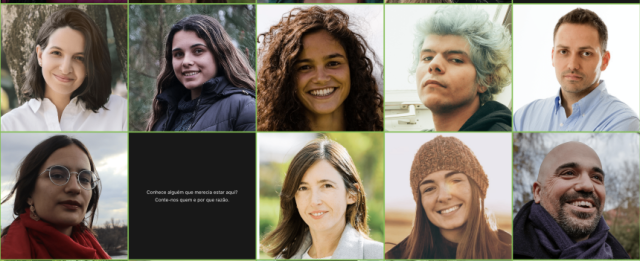
"Faces that want to change the future of the planet" featuring Dr. João Pedro Gouveia
"Portugal’s energy poverty paradox" for Canada's The Independent with Miguel Macias Sequeira
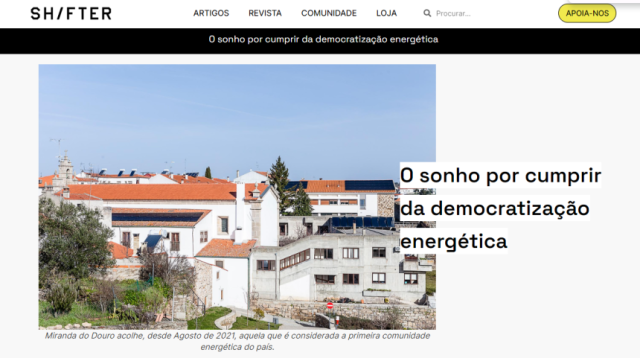
"The unfulfilled dream of energy democratization" with Miguel Macias Sequeira for SHIFTER
"This is where you die of cold" Energy Poverty in Portugal
ADENE interviews João Pedro Gouveia
SHARE ON