Pedro Palma
Researcher at NOVA University of Lisbon
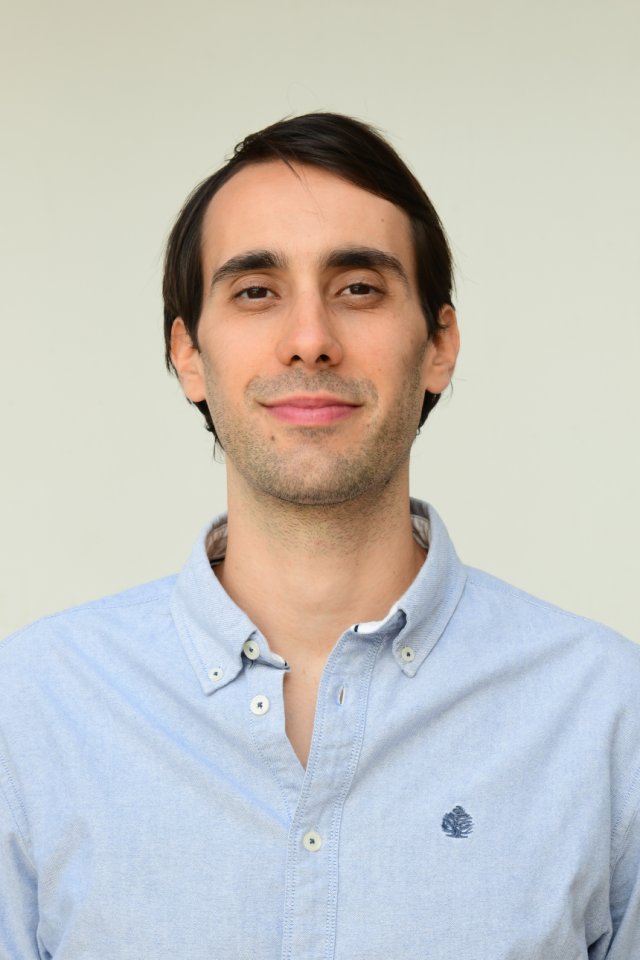
Pedro Palma holds a PhD in Environment and Sustainability (2024) from NOVA University of Lisbon. He has a MSc. degree in environmental engineering, environmental systems engineering profile, from the NOVA School of Science and Technology, NOVA University of Lisbon. He has been a researcher at CENSE since 2017, developing research work on buildings energy modelling, building cost-effectiveness renovation analysis, energy poverty vulnerability metrics, and climate change adaptation and mitigation strategies.
He has participated in national and European projects such as Intermunicipal Plans for Climate Change Adaptation of Portuguese regions Alentejo Central and Oeste; the National Roadmap for Carbon Neutrality 2050 of Portugal; the project LIGAR! Energy Efficiency for All!, about the identification of energy poverty hotspots for local action in Portugal; the project Ponto de Transição, which implemented and is currently running a physical one-stop-shop for energy poverty mitigation; the Climate-KIC project SUSHI - Sustainable Historic City Districts; the Menu de Renovação Verde, which developed a digital one-stop-shop for home renovation; the IEA's UsersTCP Task on Hard-to-reach Energy Users; the EPAH - Energy Poverty Advisory Hub, and the project LOCATEE – Local authorities tackling energy poverty in private multi-apartment buildings.
Varieties of domestic energy deprivation in private multi-apartment buildings. Insights from Poland, Portugal and Greece. [2025]
Arquitectura, Sostenibilidad, Resiliencia y Salud. Hacia una Sociedad en Armonía con el Medio Ambiente [2024]
Exploring Energy Poverty in Urban and Rural Contexts in the Era of Climate Change: A Comparative Analysis of European Countries and Israel [2024]
Comparative analysis of energy poverty definition and measurement in Portugal and Spain [2024]
A New Way to Mitigate Energy Poverty: Lessons from the Transition Point ‘One-Stop Shop’ Pilot [2024]
2nd Phase of the "Edifícios + Sustentáveis" (More Sustainable Buildings) Support Program [2021-2023]
The 2nd Phase of the "Edifícios + Sustentáveis" (More Sustainable Buildings) Support Program is a government initiative in Portugal that aims to promote sustainable building practices and energy efficiency in buildings.Energy Inclusion Project [2022-2023]
Provide support to EDP - Social Impact Office for their project on Social Inclusion"Feasibility of decarbonizing residential buildings – challenges and proposals in the context of Portugal" [2022-2023]
"Feasibility of decarbonizing residential buildings – challenges and proposals in the context of Portugal" study developed for ZERO - Associação Sistema Terrestre Sustentável and European Climate FoundationGreen Renovation Menu [2020-2021]
The "Menu Renovação Verde" aims to help homeowners increase the sustainability of their homes, as well as improve their comfort conditions and reduce their energy bills, with a particular focus on those who are most vulnerable and those living in older and inefficient buildings.LIGAR - Eficiência energética para todos! [Energy Efficiency for All!] [2017-2019]
“LIGAR – Energia para todos!” is an initiative that aims to develop inclusive strategies to mitigate energy poverty and increase the energy efficiency among the population in disadvantaged socioeconomic conditions and info-exclusion.PIAAC OESTE - Intermunicipal Plan for Climate Change Adaptation in Oeste region, Portugal [2018-2019]
Oeste PIAAC is an action plan to face climate change for the inter municipal region of OESTE in Portugal. In this sense, it contains risk mapping for the main climate vulnerabilities and adaptation measures, taking into account a vision of the future for the region it covers. For this to be possible, stakeholders and decision makers will be involved throughout the process of drawing up the Plan, in a logic of participation and knowledge sharing.Jun
202319
8th Annual Seminar of the PhD Programme in Environment and Sustainability Studies
Jun
202302
LA CHANGE - Science CHANGing Policy event
Apr
202319
15th edition of EXPO FCT NOVA
Mar
202309
WEBINAR - Launch of the 2nd #EPAHcall for local governments to request technical assistance on energy poverty
Mar
202301
2nd OPEN CALL for technical assistance to tackle energy poverty
Feb
202328
Our EPAH 2nd online course is launched

Pedro Palma and João Pedro Gouveia interviewed for EU LIFE LOCATEE project article

Pedro Palma features in Euractiv article

Pedro Palma interviewed for Entre Rios Magazine
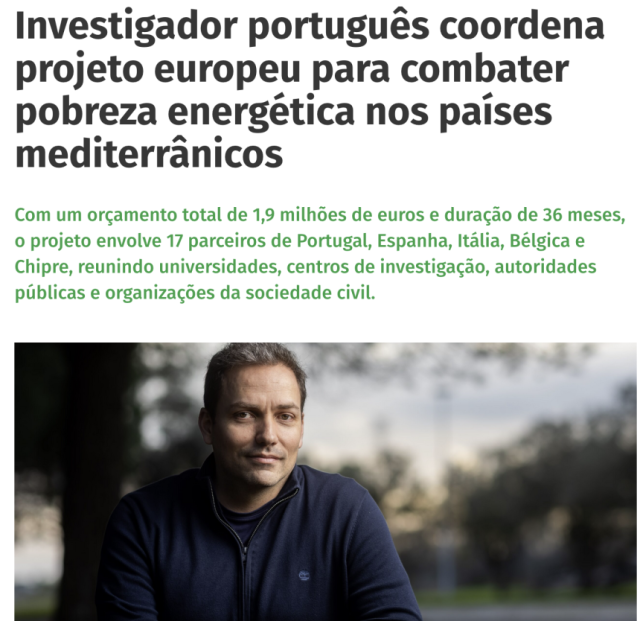
João Pedro Gouveia coordinates new European project to fight energy poverty in Mediterranean countries

Seven organizations offer praise and criticism of the Social Climate Plan
