Miguel Macias Sequeira
Researcher at NOVA University of Lisbon
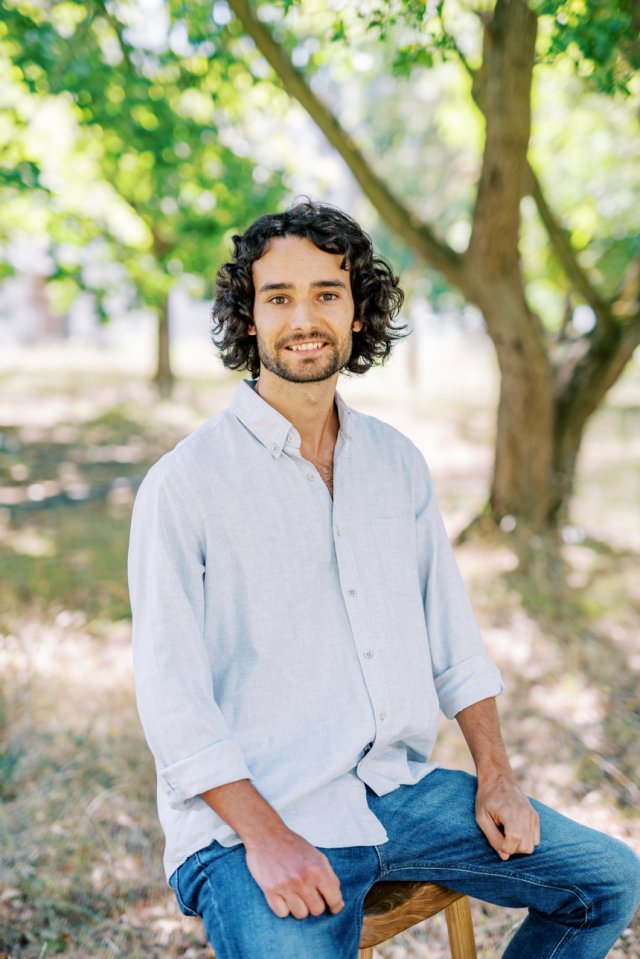
Miguel Macias Sequeira holds a PhD in Environment and Sustainability from the School of Science and Technology of NOVA University of Lisbon and a MSc degree in Environmental Engineering from the School of Science and Technology of NOVA University of Lisbon. Currently, Miguel is an energy and climate researcher at CENSE – Center for Environmental Research and Sustainability, NOVA-FCT – NOVA University of Lisbon. His research explores topics such as energy transitions, energy justice, energy policies, energy poverty, hard-to-reach energy users, energy efficiency, building renovation, renewable energy, one-stop shops, energy communities, stakeholder engagement, and sustainable cities and communities. He is the author or co-author of 7 peer-reviewed articles and 5 book chapters (h-index 4). Miguel has contributed to 10 reports, policy briefs, and practical guides, and has participated in 26 scientific conferences with peer review process. Miguel is also collaborating in several international and national research projects, such as the Energy Poverty Advisory Hub (EPAH), the IEA UsersTCP Task on Hard-to-reach Energy Users, project "Ponto de Transição" that is piloting physical one-stop-shop approaches to mitigate energy poverty, and "Menu de Renovação Verde" that launched a digital one-stop-shop for home renovation.
Miguel is the Executive Coordinator of the Telheiras/Lumiar Renewable Energy Community which is a pioneer energy community in Portugal and a member of REScoop.eu, promoted by the Local Partnership of Telheiras and the Lumiar Civil Parish . He is also an environmental activist at GEOTA - one of the key environmental NGOs in Portugal - currently serving as Vice-President. Since 2021, Miguel is one of the European Union's Climate Pact Ambassadors in Portugal. Miguel has dedicated significant effort to knowledge extension and dissemination.
Public Consultation Assessment of the Portuguese Social Climate Plan 2026-2032 [2025]
Observe, Inform, Facilitate and Support: An integrated approach to accelerate the development of renewable energy communities in Portugal [2025]
Sharing Is Caring: Exploring Distributed Solar Photovoltaics and Local Electricity Consumption through a Renewable Energy Community [2024]
AI4SUSTAIN - Empowering the European Workforce for the Green and Digital Transition through AI-Enhanced Skills Development [2026-2030]
AI4SUSTAIN is a Horizon Europe MSCA Staff Exchanges project (Grant No. 101296730) bringing together 11 partners — universities, industry, SMEs and policy organisations — to tackle one of Europe's most pressing challenges: preparing workers for the green and digital transitions through AI-enhanced skills development.Telheiras/Lumiar Renewable Energy Community [2021-2030]
A pioneer citizen-led renewable energy community in Portugal, promoting collective investment in solar power and managing energy generation and sharing with the participation of local households, businesses, condominiums, associations, and authorities, promoting energy poverty mitigation and energy democratization.EP MED - Catalysing cross-sectoral networks of national observatories and regional hubs to coordinate actions against households energy poverty in EU Mediterranean countries (LIFE) [2026-2029]
EP-MED tackles household energy poverty across Mediterranean EU countries (Portugal, Spain, Italy, Cyprus) through a 36-month, CINEA-funded LIFE action. The consortium of 12 full and 6 associated partners will assess vulnerable households, deliver interventions including energy efficiency kits (LED lamps, water-aerating taps, thermometers), build local stakeholder capacity, and generate policy recommendations, aiming to reduce energy vulnerability and inform replicable, evidence-based policy across the region.EPAH EU Energy Poverty Advisory HUB [2025-2028]
The European Commission's initiative, Energy Poverty Advisory Hub (EPAH), is the leading EU initiative to eradicate energy poverty and accelerate the just energy transition in European local communities. EPAH’s mission is to be the central platform of energy poverty expertise in Europe for local communities and all stakeholders interested in taking action to combat energy poverty in Europe by providing direct support, learning opportunities, and research results, and by building a collaborative network of stakeholders interested in taking action to combat energy poverty in Europe.DOOBRA 2.0 – Community Laboratory for Energy Action [2026-2028]
DOOBRA 2.0 tackles energy poverty in Lisbon by combining energy literacy, personalised household support, energy efficiency measures and community participation. The project works through local organisations and community leaders to empower vulnerable households and co-create practical, locally grounded solutions.Energy Poverty Vulnerability Mapping for Portugal - Portuguese Energy Poverty Observatory (ONPE-PT) [2025-2027]
This project develops a national energy poverty index and maps energy poverty across Portugal at the district and municipality levels, covering mainland Portugal, the Azores, and Madeira. The work also discusses the indicators defined in the ELPPE (Estratégia de Longo Prazo para o Combate à Pobreza Energética, Portugal's national long-term strategy against energy poverty), spanning primary indicators (inability to keep the home adequately warm, poor energy performance of dwellings, damp/mould/rot problems, thermal discomfort in summer, and high energy expenditure burden) and contextual indicators (poverty risk, utility debt, disconnections, self-supply from renewables, and energy literacy).May
202515
Visit of the REDI4HEAT European project (ADENE) to the Telheiras/Lumiar Renewable Energy Community
May
202514
Educating for Energy Sustainability (Casa Madre Luiza Andaluz)
May
202512
2nd ENTRACK Community of Practice on Inclusive Renewable Energy Communities
May
202505
ACT NOW Mayors' Conference 2025
Apr
202530
EXPO FCT 2025
Apr
202514
INCLU:DE PEER EXCHANGES - Addressing energy poverty through inclusive local measures
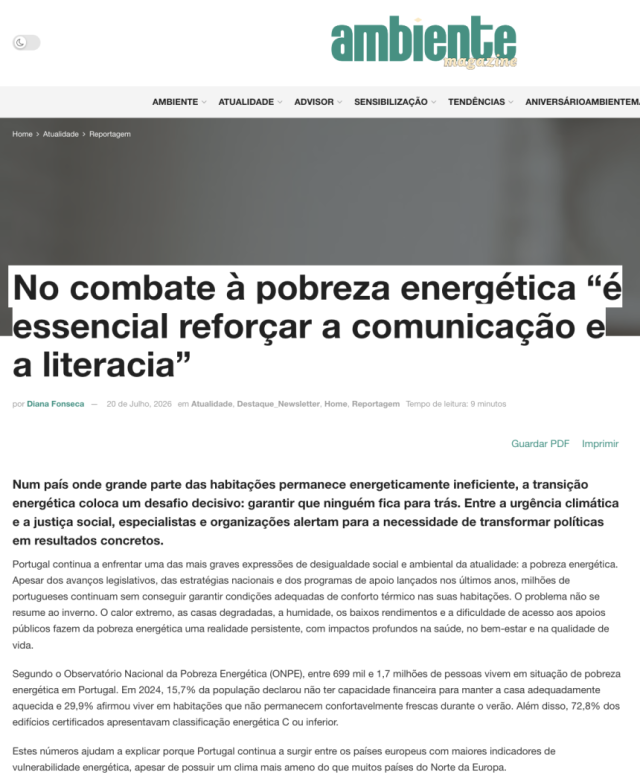
João Pedro Gouveia and Miguel Sequeira featured in the Ambiente magazine article "In the fight against energy poverty, it is essential to strengthen communication and literacy"
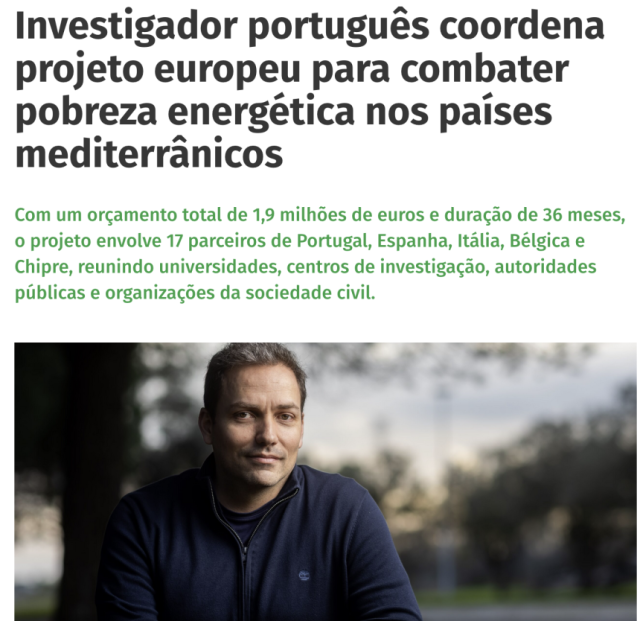
João Pedro Gouveia coordinates new European project to fight energy poverty in Mediterranean countries
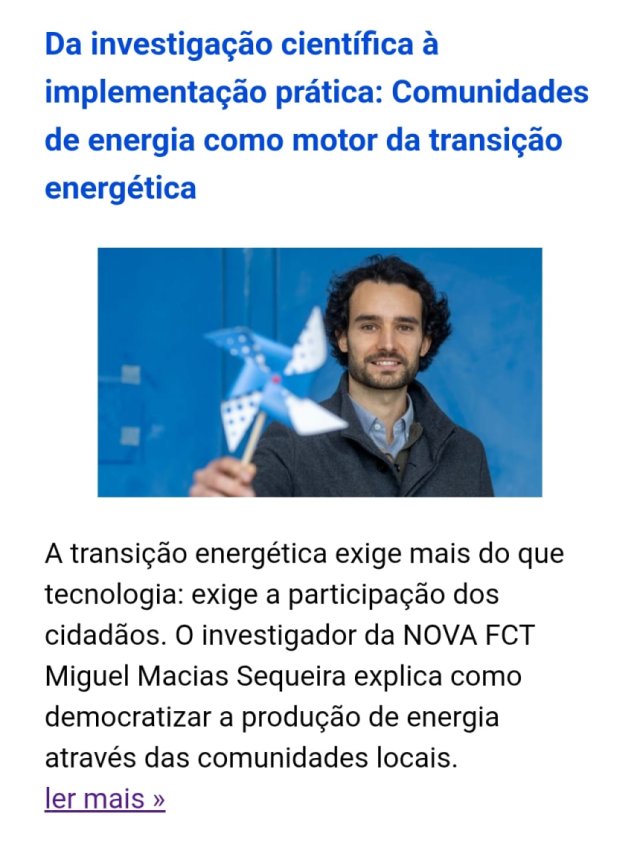
From scientific research to practical implementation: energy communities as an engine for the energy transition
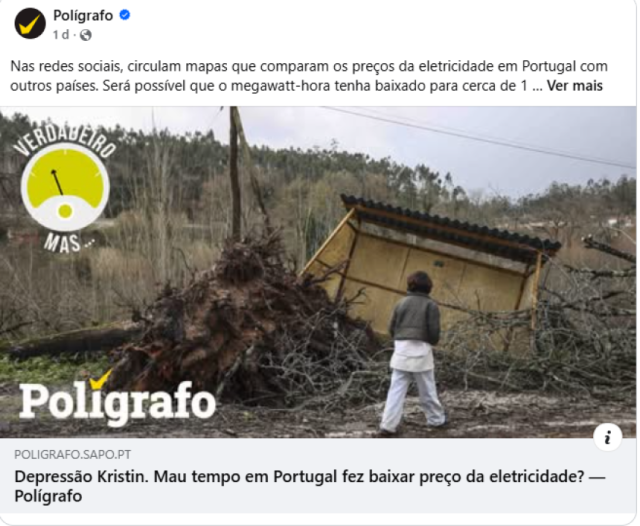
Factcheck - Kristin's depression. Did bad weather in Portugal cause electricity prices to drop?
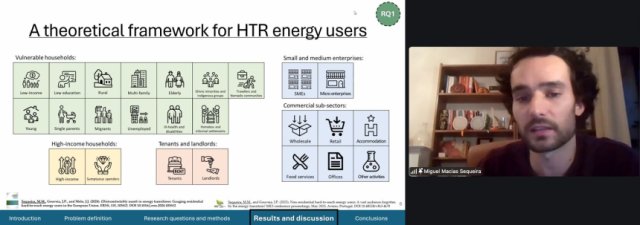
Miguel Macias Sequeira received the Young Researcher Award 2025 from APEEN - Portuguese Association for Energy Economics
