Pedro Palma
Researcher at NOVA University of Lisbon
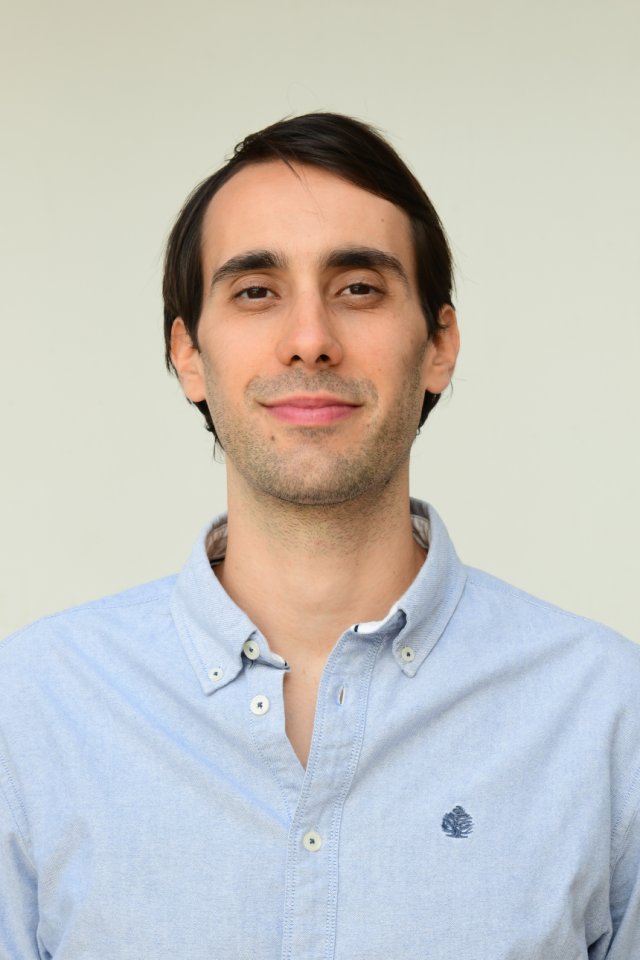
Pedro Palma holds a PhD in Environment and Sustainability (2024) from NOVA University of Lisbon. He has a MSc. degree in environmental engineering, environmental systems engineering profile, from the NOVA School of Science and Technology, NOVA University of Lisbon. He has been a researcher at CENSE since 2017, developing research work on buildings energy modelling, building cost-effectiveness renovation analysis, energy poverty vulnerability metrics, and climate change adaptation and mitigation strategies.
He has participated in national and European projects such as Intermunicipal Plans for Climate Change Adaptation of Portuguese regions Alentejo Central and Oeste; the National Roadmap for Carbon Neutrality 2050 of Portugal; the project LIGAR! Energy Efficiency for All!, about the identification of energy poverty hotspots for local action in Portugal; the project Ponto de Transição, which implemented and is currently running a physical one-stop-shop for energy poverty mitigation; the Climate-KIC project SUSHI - Sustainable Historic City Districts; the Menu de Renovação Verde, which developed a digital one-stop-shop for home renovation; the IEA's UsersTCP Task on Hard-to-reach Energy Users; the EPAH - Energy Poverty Advisory Hub, and the project LOCATEE – Local authorities tackling energy poverty in private multi-apartment buildings.
EFPORE-SE: D2.1 Project inception report [2024]
Hard-to-reach energy users: An ex-post cross-country assessment of behavioural-oriented interventions [2023]
Executive Summary - Tackling energy poverty: the potential of a mobile ‘one-stop shop’ [2023]
Feasibility of decarbonizing residential buildings – challenges and proposals in the Portuguese Context [2023]
Public Consultation Document on the Portuguese National Energy Poverty Strategy 2022-2050 [2023]
AI4SUSTAIN - Empowering the European Workforce for the Green and Digital Transition through AI-Enhanced Skills Development [2026-2030]
AI4SUSTAIN is a Horizon Europe MSCA Staff Exchanges project (Grant No. 101296730) bringing together 11 partners — universities, industry, SMEs and policy organisations — to tackle one of Europe's most pressing challenges: preparing workers for the green and digital transitions through AI-enhanced skills development.EP MED - Catalysing cross-sectoral networks of national observatories and regional hubs to coordinate actions against households energy poverty in EU Mediterranean countries (LIFE) [2026-2029]
EP-MED tackles household energy poverty across Mediterranean EU countries (Portugal, Spain, Italy, Cyprus) through a 36-month, CINEA-funded LIFE action. The consortium of 12 full and 6 associated partners will assess vulnerable households, deliver interventions including energy efficiency kits (LED lamps, water-aerating taps, thermometers), build local stakeholder capacity, and generate policy recommendations, aiming to reduce energy vulnerability and inform replicable, evidence-based policy across the region.EPAH EU Energy Poverty Advisory HUB [2025-2028]
The European Commission's initiative, Energy Poverty Advisory Hub (EPAH), is the leading EU initiative to eradicate energy poverty and accelerate the just energy transition in European local communities. EPAH’s mission is to be the central platform of energy poverty expertise in Europe for local communities and all stakeholders interested in taking action to combat energy poverty in Europe by providing direct support, learning opportunities, and research results, and by building a collaborative network of stakeholders interested in taking action to combat energy poverty in Europe.Energy Inclusion (Inclusão Energética)_Social Impact Bounds [2026-2028]
The project addresses energy poverty across four Portuguese regions (Centro, Algarve, Norte and Alentejo) and funds home renovation interventions to improve thermal comfort and energy efficiency. Renovation works will be done by volunteers. The project then measures the health, comfort and energy impact of these renovations through a structured before-and-after evaluation, submitted as a Social Impact Bond (Títulos de Impacto Social) under the Portugal Inovação Social programme.LOCATEE - LOCal Authorities to Tackle Energy povErty in private multi-apartment buildings [LIFE] [2024-2027]
LOCATEE's overarching goal is to support local municipalities in addressing energy poverty through the renovation of private multiapartment buildings for vulnerable residents.Energy Poverty Vulnerability Mapping for Portugal - Portuguese Energy Poverty Observatory (ONPE-PT) [2025-2027]
This project develops a national energy poverty index and maps energy poverty across Portugal at the district and municipality levels, covering mainland Portugal, the Azores, and Madeira. The work also discusses the indicators defined in the ELPPE (Estratégia de Longo Prazo para o Combate à Pobreza Energética, Portugal's national long-term strategy against energy poverty), spanning primary indicators (inability to keep the home adequately warm, poor energy performance of dwellings, damp/mould/rot problems, thermal discomfort in summer, and high energy expenditure burden) and contextual indicators (poverty risk, utility debt, disconnections, self-supply from renewables, and energy literacy).Sep
202526
European Researchers Night 2025
Jul
202517
Pedro Palma presents at the 3rd CoP Meeting of the EU ENTRACK Project.
Jul
202501
1st EPAH Practitioners Event on Summer Energy Poverty
Jun
202526
1st Local Meeting of LIFE LOCATEE Project in Torres Vedras.
Jun
202524
“Construyendo el camino hacia una Transición Energética Justa (y efectiva)”, Madrid
Jun
202517
NOVA FCT Science Days

Pedro Palma and João Pedro Gouveia interviewed for EU LIFE LOCATEE project article

Pedro Palma features in Euractiv article

Pedro Palma interviewed for Entre Rios Magazine
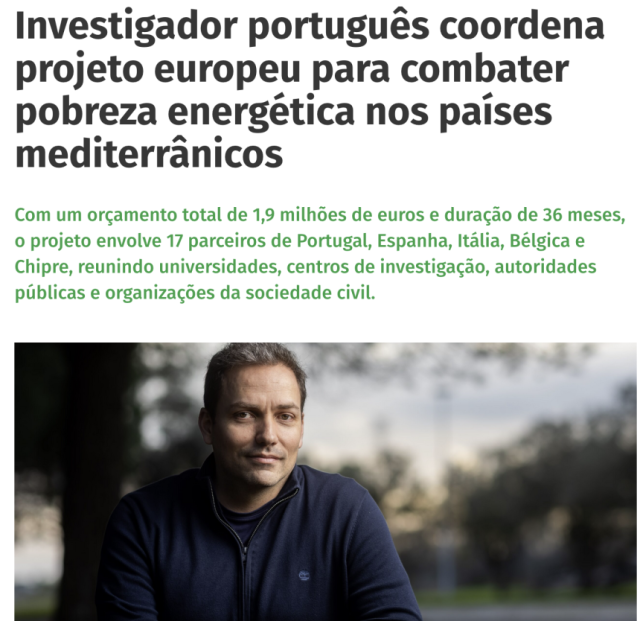
João Pedro Gouveia coordinates new European project to fight energy poverty in Mediterranean countries

Seven organizations offer praise and criticism of the Social Climate Plan
